A jet aircraft is an aircraft propelled by jet engines. Jet aircraft generally fly much faster than propeller-powered aircraft and at higher altitudes — as high as 10,000 to 15,000 meters (about 33,000 to 49,000 ft). At these altitudes, jet engines achieve maximum efficiency over long distances. The engines in propeller powered aircraft achieve their maximum efficiency at much lower altitudes. Jet aircraft can move faster than sound.
Henri Coandă, a Romanian Engineer, was the first to build a jet plane in 1910 — the Coanda-1910. Later on, two engineers, Frank Whittle in the United Kingdom and Hans von Ohain in Germany, developed the concept independently during the late 1930s, although credit for the first turbojet is given to Whittle.[citation needed] The concept had already been discussed as early as August 1928 by Frank Whittle at Flying School, Wittering, but Hans von Ohain also wrote in February 1936 to Ernst Heinkel, telling him of the design and its possibilities. However, it can be argued that A. A. Griffith, who published a paper in July 1926 on compressors and turbines, which he had been studying at the RAE, also deserves priority credit, perhaps more than either Frank Whittle or Hans von Ohain.
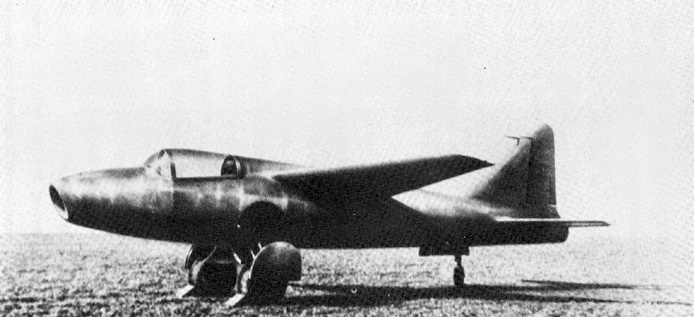
The first turbine-equipped jetplane was designed on paper in late 1929 when Frank Whittle of the British Royal Air Force sent his concept to the Air Ministry to see if it would be of any interest to them. The first manufactured turbine jetplane was the Heinkel He 178 turbojet prototype of the German Air Force (Luftwaffe), piloted by Erich Warsitz on August 27, 1939.
The first flight of the Italian Caproni Campini N.1 motorjet prototype was on August 27, 1940. Test pilot Major Mario De Bernardi of the Regia Aeronautica was at the controls.
The British flew their Gloster E.28/39 prototype on May 15, 1941, powered by Sir Frank Whittle's turbojet, and piloted by Flt Lt PG Sayer. When the United States learned of the British work, it produced the Bell XP-59 with a version of the Whittle engine built by General Electric, which flew on September 12, 1942, piloted by Col L. Craigie.
The first operational jet fighter was the Messerschmitt Me 262, made by Germany during late World War II. It was the fastest conventional aircraft of World War II — although the rocket-powered Messerschmitt Me 163 Komet was faster. Mass production started in 1944, too late for a decisive effect on the outcome of the war. About the same time, the United Kingdom's Gloster Meteor was limited to defense of the UK against the V1 flying bomb and ground-attack operations over Europe in the last months of the war. The Imperial Japanese Navy also developed jet aircraft in 1945, including the Nakajima J9Y Kikka, a crude copy of the Me-262
On November 8, 1950, during the Korean War, United States Air Force Lt. Russell J. Brown, flying in an F-80, intercepted two North Korean MiG-15s near the Yalu River and shot them down in the first jet-to-jet dogfight in history.
BOAC operated the first commercial jet service, from London to Johannesburg, in 1952 with the de Havilland Comet jetliner.
The fastest military jet plane was the SR-71 Blackbird at Mach 3.2. The fastest commercial jet plane was the Tupolev Tu-144 at Mach 2.35.


0 comments:
Post a Comment